

Case study
A CRM you talk to, inside the AI assistant you already use.
How we took our own product from an idea to a working CRM in six months, where a 30-second voice note replaces minutes of form filling.
- Product
- Know Who CRM. Our own product.
- What we built
- A connector that lets an AI assistant keep your contacts, and a web app for sign-up, teams and billing
- How it was built
- In stages, each proven before the next began
- When
- April to September 2026
The challenge.
Most CRMs fail for a simple reason: people don't put data into them. Logging a meeting means forms, dropdowns and required fields. So the notes never get written, and the CRM slowly goes empty.
We felt this ourselves. Our work comes from the people we meet, and a CRM only helps if what you learnt at a meeting ends up in it.
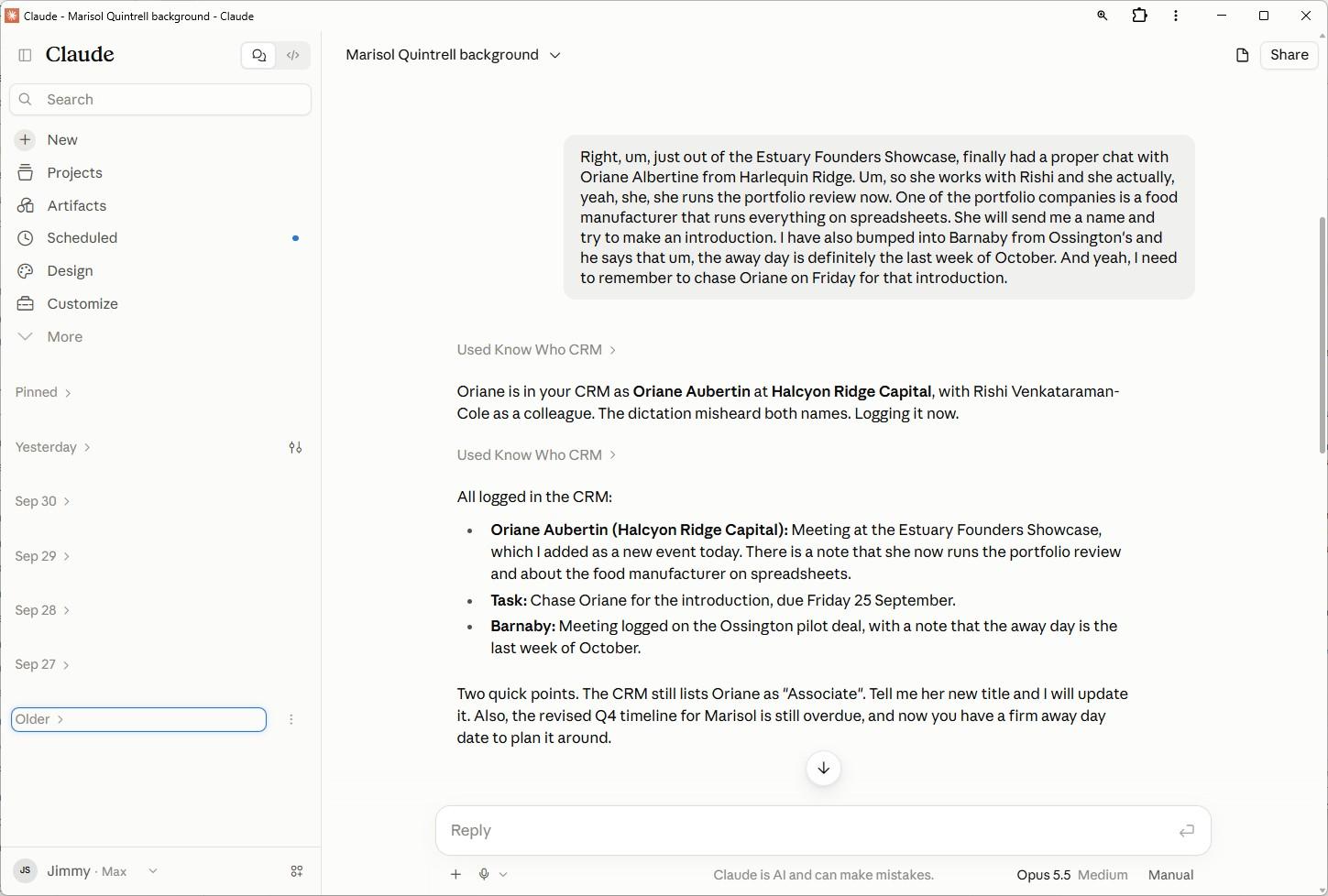
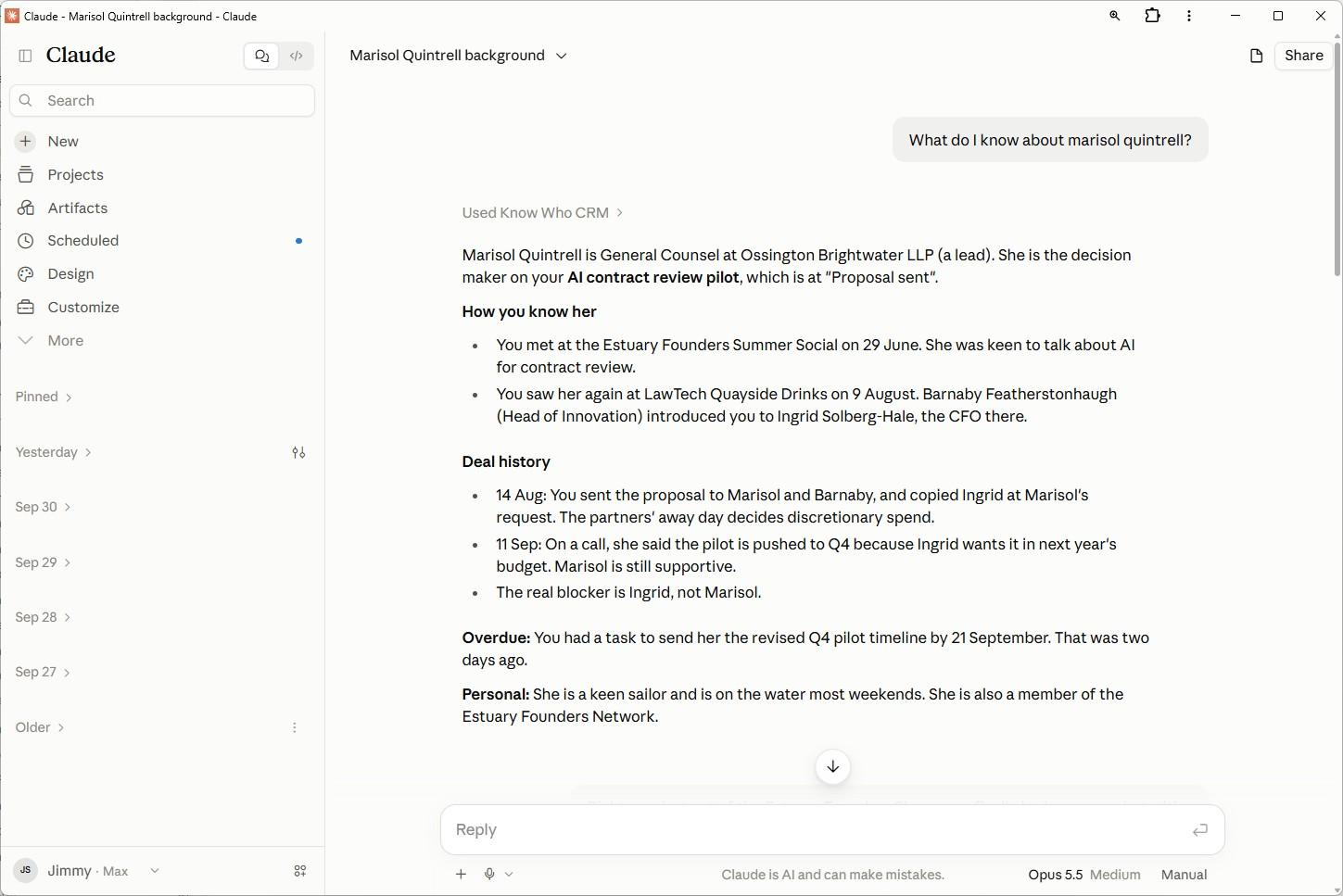
The idea was to have no app to open at all. The CRM lives inside the AI assistant you already talk to every day. You say what happened, and it's recorded. You say a name, and you get back everything you know about that person.
That raised four hard questions:
- How do you turn a rambling voice note into clean, linked records, reliably?
- How do you stop the AI creating duplicates, or guessing wrong about who someone is?
- How do you keep each customer's contacts private in one shared system?
- How do you run it cheaply, with UK data protection built in from day one?
What we built.
Know Who works as a connector: an add-on that lets an AI assistant read and write your contacts, much as it might read your calendar. You never open a CRM screen.
- Log a meeting by talking. One spoken note creates or updates every person, company, meeting, note and follow-up it mentions. It then says what it did in plain words, so you can correct a mistake on the spot.
- Find what you meant. "The lawyer I met in Bristol" works as well as a full name.
- Everything in one answer. All you know about a person, a company or a deal.
- Deals and the people behind them. Who's involved, and their role, such as the person championing it or the one who decides.
- Plans and teams. Free, Pro and Team plans, with each customer's contacts kept separate.
- Ready for launch. A privacy policy, a data processing agreement and user guides, written alongside the build.
The hard parts.
- Designing for the AI, not just for people. An assistant chooses from the tools a connector offers. We cut the choice from 30 tools to 12, and logging a meeting from 8 to 10 steps to one. Fewer, clearer choices mean the assistant gets it right more often.
- No silent guessing. If a name could match two people, nothing is saved until you choose. Anything assumed, such as creating a new company, is reported back.
- Each customer's data kept apart. The system works out who you are from your sign-in, never from what the assistant sends, so one customer's assistant can't reach another's records, even by mistake. Logs record which action ran, never what was said about a contact.
The result.
- 30 seconds
- a spoken note, instead of minutes of forms
- 1 step
- to log a meeting, down from 8 to 10
- 6 months
- from an idea to a working product
We use it ourselves to log the people we meet, from conferences to networking breakfasts. We tested voice logging for real at London Tech Week in June 2026, logging conversations straight from the conference floor. A check before launch found four other CRMs using the product's original name, so it was renamed before launch, not after.
For the technical reader
| Layer | Technology |
|---|---|
| Connector | MCP server on Cloudflare Workers |
| Data | Neo4j Aura, Cloudflare D1 |
| Search by meaning | Voyage AI, alongside exact matching |
| Sign-in | Clerk |
| Billing | Stripe |
The connector offers 12 tools: five for reading, one for capture, and six small building blocks for edits. Every write returns one of three answers: done, cannot proceed, or needs a decision. The AI calls fixed, tested tools and never writes its own database queries. The customer is identified from the signed-in session on the server. Plan limits live in the product's own database and are checked on every call, and Stripe is only asked when a paid period ends, so there are no webhooks to fail. The product moved from Azure to Cloudflare, which cut cost and added a web application firewall and rate limiting. Relationship data is stored in the UK, and only sign-in cookies are set. Hosting is estimated at about $5 to $15 a month.
Not sure which way in?
A first conversation costs nothing. We'll tell you where we'd start, and if the answer is not yet, we'll say so.
Or email info@khiliad.com, or .